Black Shitake Gruel
For thousands of years, gruel was the ultimate sustaining dish—a nutrient-dense, highly adaptable meal that formed the cornerstone of daily diets across the globe. From the millet-based porridges of ancient Roman settlements and medieval Europe to the everyday provisions of 18th-century farming communities, slow-cooked grains were valued for their nourishment and resourcefulness (Gyulai, 2014; Svanberg & Ståhlberg, 2024). Before the modern era, a well-made gruel was not a punishment; it was a celebrated, wholesome canvas for seasonal vegetables, local herbs, and rich broths.
So, how did such a fundamental dish lose its culinary standing? The shift occurred during the Industrial Revolution. With rapid urbanisation and the establishment of the British workhouse system in the 19th century, authorities needed a way to feed massive labor forces as cheaply as possible. Gruel was stripped of its flavor and culinary care, reduced to a watered-down, monotonous oat ration designed merely for subsistence. Thanks to literary depictions of these grim workhouse conditions, gruel became permanently associated with deprivation, falling entirely out of fashion.
But it’s time to reclaim the word and the dish. At its core, a gruel is simply a slow-simmered grain dish—much like a rustic risotto or a savory congee—that extracts the maximum nutritional value and deep, earthy flavors from its ingredients. This Black Shiitake Gruel elevates the concept back to its dignified origins. Packed with the powerhouse combination of barley, yellow split peas, and the deep umami of black shiitake and red miso, it is a restorative, iron-rich, and deeply comforting bowl that proves history's oldest meals still have a place on the modern table.
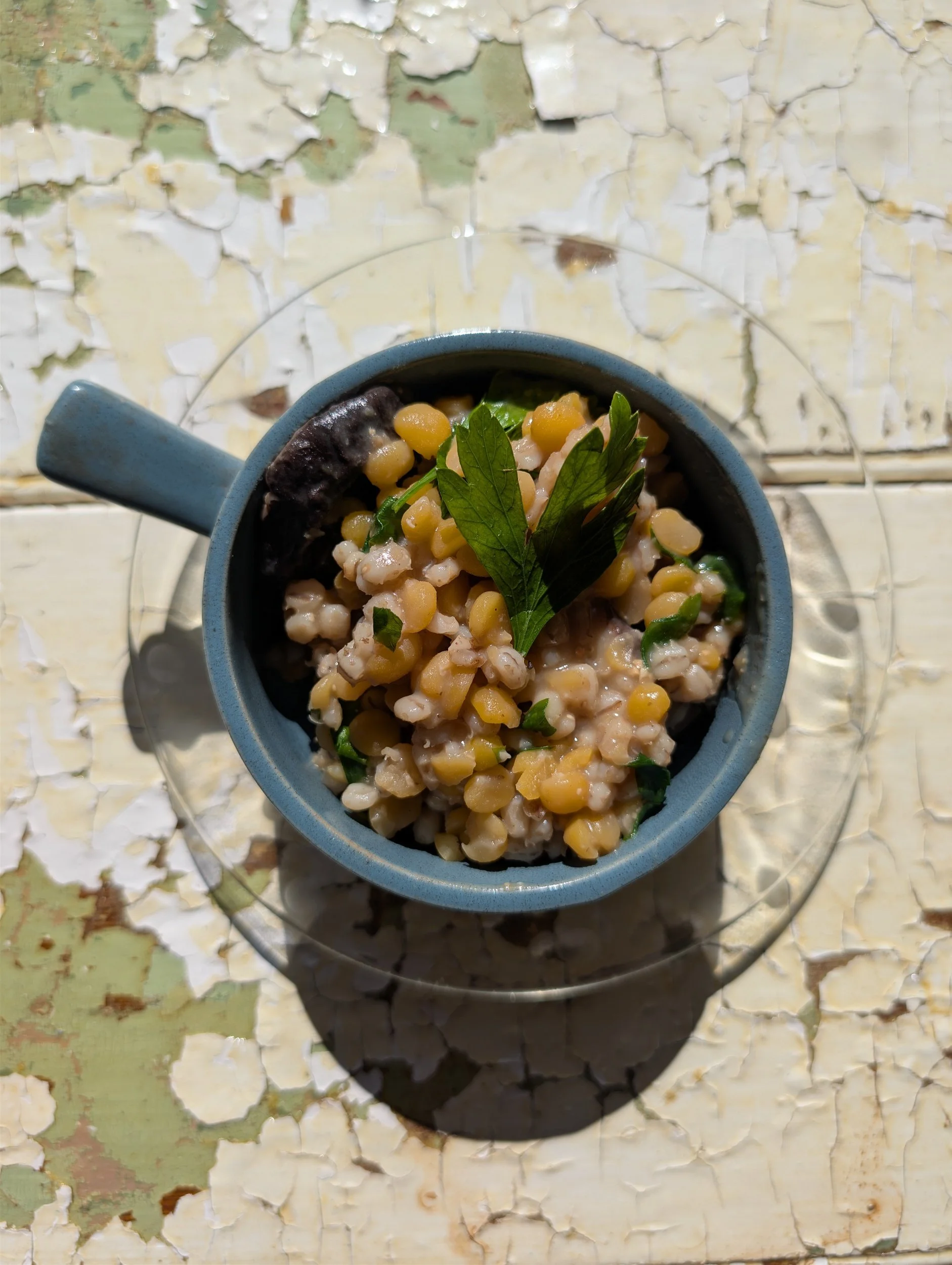
Ingredients
6 dried black shiitake mushrooms
1/3 cup barley
2 tbsp red wine vinegar
Water (enough to cover and boil the barley)
1 Lucky Iron Fish (optional)
1/2 cup yellow split peas
1 mushroom bouillon cube
1 cup boiling water
2 tbsp fresh Italian flat-leaf parsley, chopped
1 tsp red miso paste
1 sprig fresh Italian flat-leaf parsley (for garnish)
Fresh cracked black pepper, to taste
Instructions
1. The Initial Boil: In a pot, combine the mushrooms barley, red wine vinegar, Lucky Iron Fish, and your starting water. Bring the mixture to a rolling boil. Reduce the heat, cover with a lid, and let it simmer for 10 minutes.
2. Build the Base: Add the yellow split peas, and the mushroom bouillon cube to the pot. Bring the liquid back to a boil, then reduce the heat, cover, and simmer for another 20 minutes.
3. Simmer to Texture: Pour in another1 cup of boiling water. Keep the lid on and continue to simmer until the split peas reach your desired consistency (a chewy texture works beautifully here).
4. Reduce: Once the peas are ready, remove the lid and allow the liquid to reduce until the gruel thickens.
5. Finish and Serve: Remove the pot from the heat. Carefully extract the Lucky Iron Fish. Stir in the chopped parsley and red miso paste until well incorporated. Serve warm, garnished with the sprig of Italian flat-leaf parsley and generously topped with fresh cracked black pepper.
References for Historical Introduction (Recipe is from SmartPigKitchen)
Gyulai, F. (2014). The history of broomcorn millet (Panicum miliaceum L.) in the Carpathian-basin in the mirror of archaeobotanical remains II. from the Roman age until the late medieval age. *Columella : Journal of Agricultural and Environmental Sciences*, *1*(1), 39–47. https://doi.org/10.18380/szie.colum.2014.1.1.39
Cited by: 27
Svanberg, I., & Ståhlberg, S. (2024). Peasant Food Provision Strategies and Scientific Proposals for Famine Foods in Eighteenth-Century Sweden. *Gastronomy*, *2*(1), 18–37. https://doi.org/10.3390/gastronomy2010002
Cited by: 1
