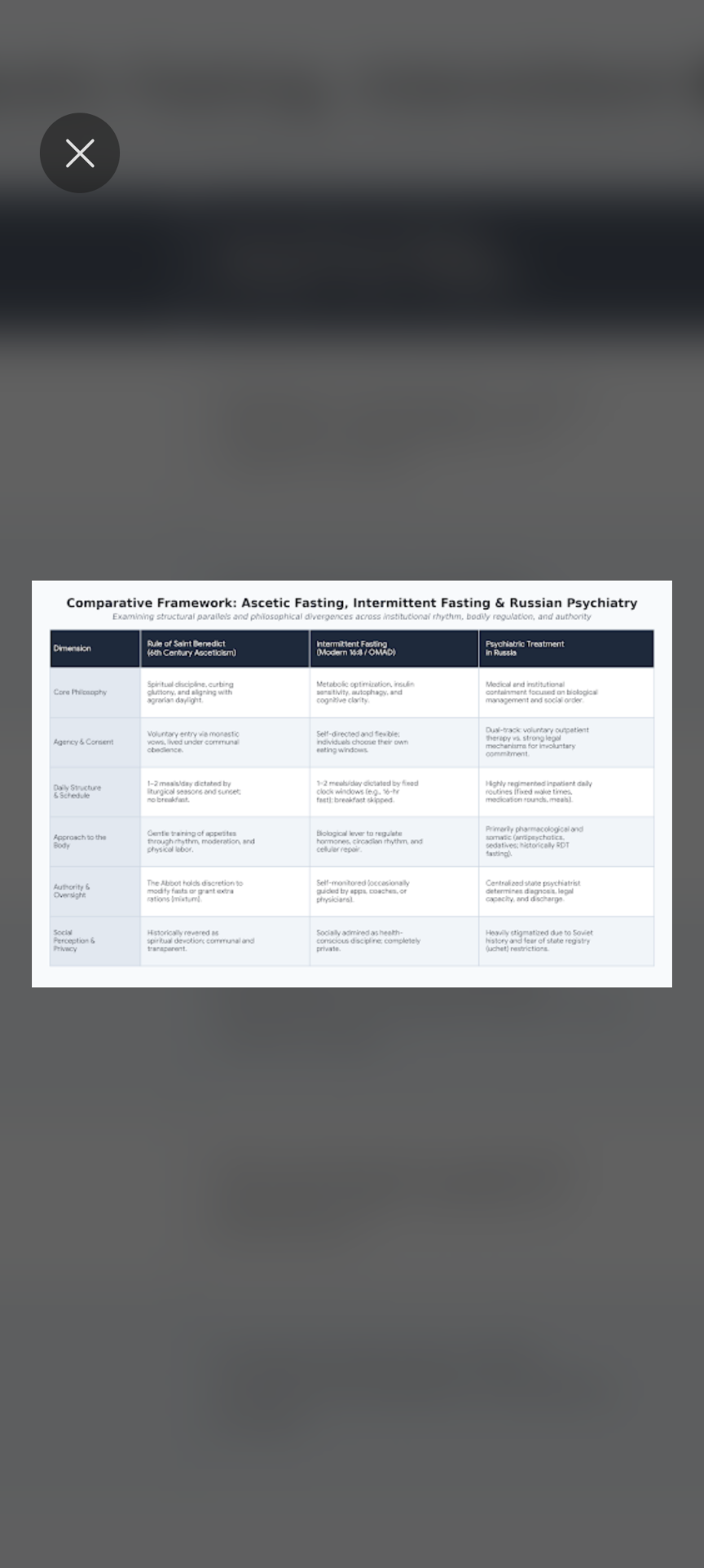
The meal schedule prescribed in the Rule of Saint Benedict (written around 530 CE) shares striking structural similarities with modern intermittent fasting (IF), particularly 16:8 and OMAD (One Meal a Day) protocols, though the underlying motivations and seasonal adjustments differ significantly.
Key Parallels
Circadian Alignment (Early Time-Restricted Feeding): Benedict explicitly forbade eating after dark so that monks would not need lamps (Chapter 42). Modern chrononutrition research similarly advocates ending eating windows several hours before sleep to align digestion with circadian rhythms.
Extended Morning Fasts: Both approaches eliminate breakfast entirely. In Benedictine life, the period between waking for the Night Office (Vigils) and the first meal at noon or 3:00 PM created a daily 16-to-23-hour fasting window—nearly identical to modern IF protocols.
Built-in Flexibility for Physical Demands: Just as modern IF practitioners adjust fasting windows around heavy training or illness, Benedict granted the Abbot authority to add a light evening snack (mixtum—a small piece of bread and wine) or alter mealtimes during intense summer agricultural labor or extreme heat.
Key Differences
Seasonal vs. Static Clocks: Modern intermittent fasting relies on mechanical clocks (e.g., always eating between 12:00 PM and 8:00 PM year-round). Benedictine time was solar and liturgical—meal times shifted naturally with the length of the day and the penitential weight of the church season.
The Role of Alcohol and Liquids: Modern IF strictly limits the fasting window to non-caloric beverages (water, black coffee, plain tea) to avoid triggering an insulin response. In the Rule, wine was considered a daily staple with meals, and small amounts of diluted wine or water were permitted outside meal hours during extreme heat or heavy labor.
Asceticism vs. Optimization: While modern IF treats fasting as a biological lever for longevity and metabolic efficiency, Benedict viewed meal timing as an exercise in temperance, humility, and detachment from bodily impulses—explicitly noting in Chapter 39 that the goal was to avoid heaviness and sluggishness during prayer and manual work.
The history of therapeutic fasting shows a clear evolution: a biologically promising treatment was once abandoned by mainstream medicine not because it didn't work, but because it was too expensive, labor-intensive, and slow to compete with pharmaceuticals. Today, intermittent fasting (IF)—paired with artificial intelligence (AI)—is reversing that equation, turning metabolic and nutritional interventions into scalable, low-cost, and clinically viable alternatives or complements to lifelong medication.
1. From Expensive Inpatient Fasts to Accessible Intermittent Fasting
In the mid-20th century, Soviet psychiatrist Dr. Yuri Nikolayev demonstrated that prolonged, 30-day water fasts could induce remission in severe psychiatric and somatic illnesses. However, the protocol required 60-day inpatient hospital stays, bespoke refeeding diets, and intensive daily nursing oversight. When fast-acting psychiatric drugs arrived and healthcare budgets tightened, hospitals could no longer afford the labor and bed costs of supervised fasting.
Modern clinical science has since distilled the core mechanisms of Nikolayev’s work into intermittent fasting (such as 16:8 time-restricted eating or alternate-day fasting). Instead of dangerous, month-long hospital fasts, short daily or weekly fasting windows safely trigger the same therapeutic pathways outpatient:
* Cellular Cleanup (Autophagy): Extended breaks from digestion lower insulin and activate autophagy, clearing out damaged proteins and dysfunctional mitochondria linked to neurodegeneration and autoimmune disease.
* Metabolic Reset: Regular fasting windows restore insulin sensitivity, putting Type 2 diabetes into remission and reducing fatty liver disease and cardiovascular risk.
* Anti-Inflammatory & Neuroprotective Effects: Shifting the brain's fuel source from glucose to ketone bodies reduces neuroinflammation, boosts Brain-Derived Neurotrophic Factor (BDNF), and stabilizes neural signaling—forming the foundation of modern metabolic psychiatry for depression, bipolar disorder, and schizophrenia.
2. How AI Solves the Cost and Supervision Barrier
Even with intermittent fasting, dietary and metabolic therapies have historically struggled to compete with a simple prescription pill because lifestyle medicine requires continuous, individualized coaching, safety monitoring, and behavioral support. AI eliminates these bottlenecks, making non-pharmacological care financially viable at scale:
* Automated, 24/7 Clinical Monitoring (Replacing Inpatient Staff): Historically, fasting required doctors and nurses to manually track vital signs, blood sugar, and refeeding safety. Today, AI integrates real-time data from continuous glucose monitors (CGMs), smartwatches, and ketone trackers to build a personalized "metabolic digital twin". AI flags dangerous glucose drops, dehydration, or medication interactions immediately, alerting a human clinician only when intervention is actually needed.
* Precision Personalization at Near-Zero Marginal Cost: Human dietitians and metabolic specialists are expensive and scarce. AI models analyze an individual’s blood biomarkers, sleep patterns, microbiome, and daily glucose responses to dynamically tailor exact fasting windows and refeeding meals—delivering bespoke clinical nutrition for pennies per day rather than hundreds of dollars per consultation.
* Safe Medication Deprescribing: Fasting rapidly alters blood sugar, blood pressure, and how the liver metabolizes psychiatric and metabolic drugs. AI decision-support tools track real-time physiological shifts to help physicians safely taper patients off expensive lifelong medications—such as insulin, GLP-1 agonists, or high-dose psychotropics—without triggering adverse rebounds.
* Proving Clinical Efficacy Without Billion-Dollar Trials: Pharmaceutical companies fund massive clinical trials because they can patent a molecule; no one can patent fasting. AI bridges this research gap by analyzing multi-omics data and real-world wearable outcomes across millions of users, generating rigorous, low-cost clinical evidence that convinces insurers and public health systems to reimburse metabolic therapies.
The New Healthcare Equation
In the 20th century, pharmaceuticals won out because a pill was cheap to distribute while supervised fasting required an army of hospital staff. In the 21st century, AI provides that clinical oversight automatically. By automating personalization, safety monitoring, and behavioral coaching, AI makes intermittent fasting and metabolic medicine drastically cheaper than chronic drug regimens—shifting healthcare from managing symptoms with lifelong prescriptions to resolving root metabolic dysfunction.
I'm a Catholic Canadian woman who reads about medicine around the world!
I'm hopeful that AI will allow us to treat the whole person with moderate preventive medicine because it works better and then we'll
all be smarter and healthier and more productive ❤️