
In Part I I showed that mental illness is a dynamic and that diagnoses are partially arbitrary, as the diagnosis in effect is determined by a third party, the arbitrator, person C.
In this section I will show that because stigma is a negative criteria, psychiatry is akin to a zero-sum game and as such the labelling of mental disorders causes an increase in diagnoses because of stigma.
The diagnostic label comes into play only when the third party, the arbitrator, person C is introduced.. If instead this conflict could be resolved without escalation, neither party would require labeling or disabling or suffer stigma.
“The game of finger pointing in psychiatry in fact increases diagnostic labeling.” K. Dana Moran
In game theory, interpersonal conflict functions as a strategic interaction where the ultimate payoff—autonomy versus institutionalization—depends entirely on whether the players choose mutual resolution or escalation. By modeling Person A and Person B as players in a zero-sum game, we can see how the failure to cooperate forces the introduction of a third party, which fundamentally changes the rules and the diagnostic outcomes for everyone involved.
The Payoff Matrix: Resolution vs. Escalation
In a standard conflict scenario, Person A and Person B have two primary strategies: Cooperate (de-escalate, set boundaries, walk away) or Defect (harass, retaliate, escalate).
* Mutual Cooperation (Internal Resolution): If both parties cooperate, they absorb the short-term discomfort of compromising or walking away. The payoff is maximum autonomy. The conflict remains a private matter of human friction. Because no third party is summoned, no external diagnostic labels are required.
* Mutual Defection (The Escalation Trap): Person A chooses to relentlessly harass, and Person B chooses physical retaliation. This mutual defection guarantees a catastrophic negative payoff. They exhaust their own capacity to manage the interaction, forcing a third-party arbitrator—the penal or psychiatric system—to step in and forcefully end the game.
Here is a classic "Stigma and Conformity" Game (often applied to seeking mental health treatment, whistleblowing, or breaking a social norm).
The Setup
* Players: Person A and Person B.
* Strategies:
* Act: Take the beneficial action that carries a risk of being labeled/stigmatized.
* Hide: Conform to the norm, avoiding the label but suffering the cost of inaction.
* The Math (Payoffs):
* +10 for the benefit of the action (e.g., getting help, speaking the truth).
* -5 for the cost of hiding/suffering in silence.
* -8 for the Stigma Penalty (the loss incurred by being labeled).
* Note: If both players act, the stigma is normalized/shared, reducing the labeling penalty to -2.
The Payoff Matrix
| | Person B: Act (Risk Label) | Person B: Hide (Avoid Label) |
|---|---|---|
| Person A: Act (Risk Label) | ( 8, 8 ) | ( 2, -5 ) |
| Person A: Hide (Avoid Label) | ( -5, 2 ) | ( -5, -5 ) |
How to Read the Matrix (Row, Column)
* Both Act (8, 8): Both get the benefit (+10) minus the reduced shared stigma (-2). They are better off together.
* Person A Acts, Person B Hides (2, -5): Person A gets the benefit (+10) but bears the full, isolating loss of the label/stigma (-8), leaving them with +2. Person B avoids the label but suffers the silent cost of the problem (-5).
* Both Hide (-5, -5): Neither incurs the labeling penalty, but both suffer the baseline cost of the unaddressed problem.
If you have a specific scenario or paragraph you wanted translated into a matrix, just drop it in and I will map out the exact players, stra
tegies, and stigma penalties for you
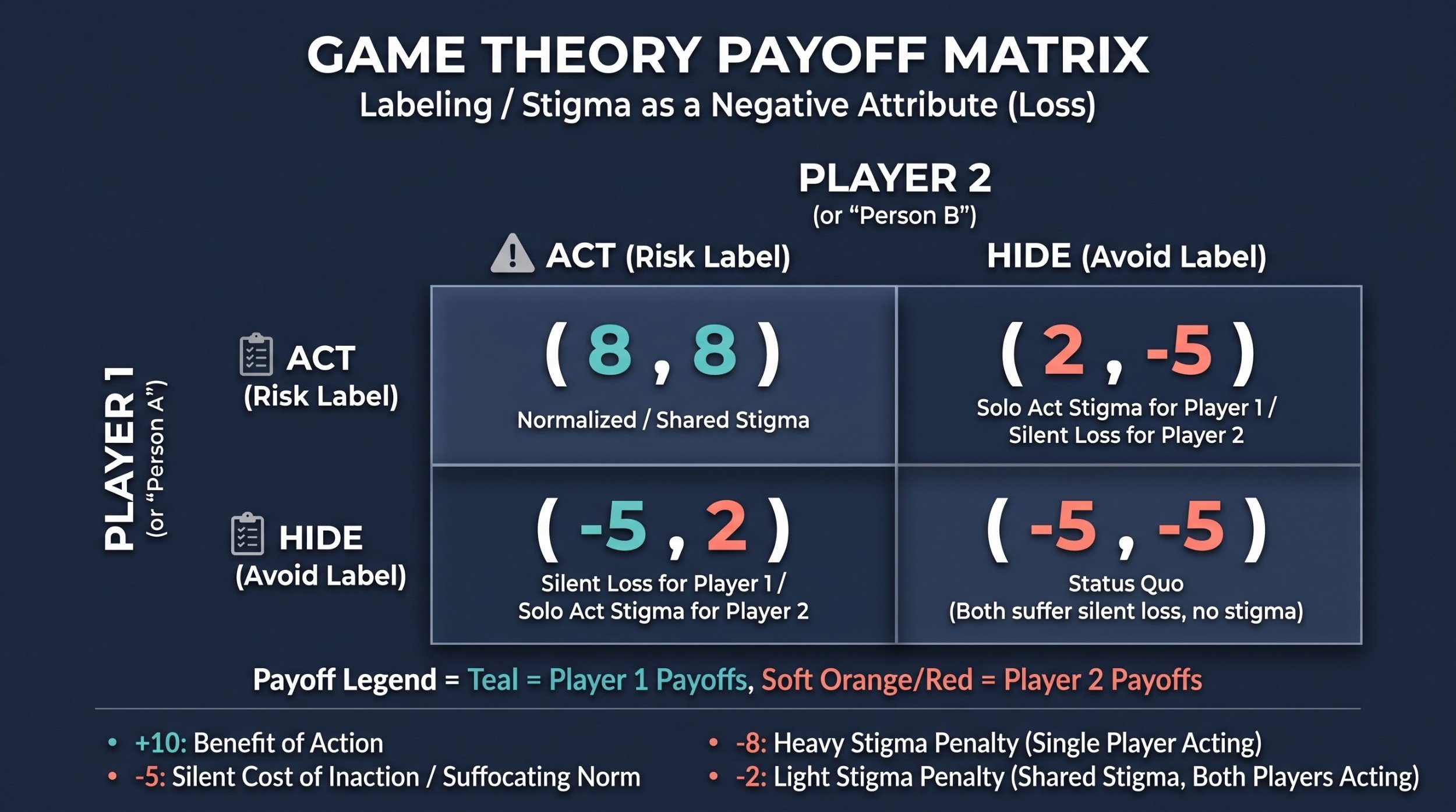
Although this appears to be a metaphor it is actually just a simple application of game theory because the diagnosis itself is a negative attribute because of stigma. This could be avoided if diagnosis wasn't merely based on the cognitive or semantic, but on the body as a whole.
The reason for this trouble is the division between analytic philosophy and first principles.
The Zero-Sum Trap: How Adversarial Systems "Disable"
In game theory, a zero-sum game means one player’s gain is mathematically balanced by another’s exact loss. When psychiatric systems operate under rigid, coercive, or highly liability-driven frameworks, they often force a zero-sum dynamic regarding agency and control.
* The Players: The System/Provider and the Patient.
* The Finite Resource: Autonomy.
* The Payoff Matrix: In a risk-averse medical model, the system prioritizes compliance and symptom suppression to minimize liability and institutional disruption. To achieve this "win," the system often employs restrictive measures (e.g., involuntary holds, forced medication, diagnostic labeling). The patient "loses" their agency, civil liberties, and self-efficacy—which can lead to long-term dependency or a "disabling" loss of functional independence.
* The Suboptimal Nash Equilibrium: Both parties adopt defensive strategies. The provider expects non-compliance and acts coercively; the patient expects coercion and acts defensively (or withdraws entirely). Neither can change their strategy without risking a worse outcome under the current rules, resulting in a stable but mutually damaging stalemate.
Shifting to a Positive-Sum Game (Win-Win)
To resolve conflict and improve outcomes, the structure of the game must be changed from a zero-sum battle for control to a positive-sum (cooperative) game, where both individuals can increase their payoffs simultaneously.
Using game theory, this transformation requires three structural shifts:
1. Redefining the Payoff Matrix (Shared Goals)
In the zero-sum model, the provider's goal is compliance and the patient's goal is escape/autonomy. To create a win-win, the game must be restructured around a shared, overarching payoff: the patient's quality of life and functional recovery.
* If the provider's "win" is redefined from managing risk to facilitating the patient's self-determined goals, their incentives align.
* When the patient succeeds in integrating into the community, the patient wins (autonomy/health) and the provider wins (successful clinical outcome/reduced systemic burden).
2. Eliminating Information Asymmetry
Many conflicts in healthcare resemble the Prisoner's Dilemma, where a lack of transparent communication breeds paranoia and defection.
* The Fix: Moving from a game of imperfect information to perfect information. Transparency. By transparently sharing the risks, legal constraints, and treatment options without paternalism, both individuals can make rational, cooperative choices rather than defensive ones.
3. Iterated Play and "Tit-for-Tat" Trust Building
A single, high-stakes encounter (like an acute crisis intervention) often defaults to a zero-sum power struggle. However, game theory proves that in iterated (repeated) games, cooperative strategies mathematically outcompete aggressive ones.
* The Fix: Providers must initiate cooperative moves (granting agency, listening to preferences) and consistently reciprocate the patient's cooperative moves. Over multiple interactions, this builds trust. The patient learns that sharing their true internal state will result in support rather than punishment (coercion), breaking the defensive Nash Equilibrium.
The Outcome: Cooperative Conflict Resolution
When a conflict arises between a patient and provider under a positive-sum framework, they do not fight over who gets to dictate the outcome. Instead, they engage in bargaining.
If person A and person B sat down and shared a meal and a civil conversation maybe no one would be diagnosed and even if they were, at least they might have a better support network ❤️
Disabling patients turns psychiatry into a zero-sum game, thereby increasing diagnoses, and reducing positive patie
nt outcomes.
K. Dana Moran
